Plot Twist: Surviving a Catastrophic Gastrointestinal Hemorrhage and Discovering my Immune System is at it Again
TRIGGER WARNING: This post discusses a serious medical emergency. I share my experience openly, but it may be upsetting for some readers. Reader discretion is advised.
Since being diagnosed with Multiple Sclerosis in 2021, I’ve lived with the metaphorical Sword of Damocles hanging over my head. I know that at any time I could have a relapse that could take away my vision, take away my ability to walk, or cause chronic pain, and that’s just to name a few of the “treats” that MS can bring about. The resulting disability could be short lived or permanent. On Tuesday January 27th, it was as if my GI tract turned to my MS and said “hold my beer”.
January 27th was a completely normal Tuesday, until it wasn’t. I had a busy and productive day at work, made dinner for my family, helped my son with his homework and then put him to bed, and I even returned to my computer to fire off one last work email at 9:21pm before starting my end of night chores. As I packed my son’s backpack for the following morning, tossed on a load of laundry, and loaded the dishwasher, I started feeling extremely lightheaded. I took a few minutes to lie down on the couch and started feeling better. Then I walked upstairs and started feeling extremely lightheaded again. I took my blood pressure. It was 105/75. Normal for me. Then I discovered that I was bleeding… a lot. I woke my husband to tell him what was going on and that I needed to go to the hospital. He asked to drive me. I told him “no, I’ll order an Uber”. I didn’t want to wake our son. He asked if we should be calling an ambulance. I told him I didn’t think it was that serious. I knew at this point that I wasn’t good to drive, but I still didn’t realize the life-threatening situation that I was in. I went downstairs to order an Uber, but started seeing stars. I called 911 instead at 10:12pm. My husband came down a minute later, having decided to tell me to call for an ambulance. He was relieved to see me already on the phone with 911. The ambulance came within minutes, which was fortunate because I nearly lost consciousness right as the paramedics arrived. Thank goodness I didn’t subject some poor Uber driver to my rapidly progressing medical emergency! On the drive to the hospital my blood pressure plunged to 53/41, a sign of the severe hypovolemic shock that I had entered.
After a lot of bolus fluids and a blood transfusion, my blood pressure stabilized and my hemoglobin stopped falling and started to slowly rise again, having fallen to 73 g/L (normal is above 120 g/L). I was sent for a CT to see if it could located the source of the bleeding. Unfortunately, the CT didn’t provide any answers. A member of the gastroenterology team came to speak with me. She informed me that they suspected diverticular bleeding was to blame for my catastrophic GI bleed. She informed me that based on the drop in my hemoglobin, they believed that I had lost over 5 units of blood, about half of my blood volume. I spent the night in the ER with my blood pressure being monitored every 15 minutes. I finally fell asleep around 10:30am only to be awoken and moved to a hallway next to a noisy nurses’ station around 11am. I soon developed a completely debilitating headache. I spent the next two hours sobbing as it felt as though my head was being split in two. I’m sure a side effect from the extreme blood loss. The plethora of beeping alarms at the nurses’ station didn’t help the situation. Eventually I was given some Tylenol, which at least took the edge off.
I was moved to a small room and given the prep solution to start preparing for a scope the following day. Drinking the solution resulted in a truly alarming about of blood loss over the course of the next 24 hours. Part-way through drinking the prep, I was moved to a ward. The nurse caring for me overnight Wednesday to Thursday suggested that we start collecting the blood output. This is when my husband truly started to understand how much blood I was losing. It was an alarming amount of blood loss to say the least.
The scope happened late in the afternoon on Thursday. This ruled out the prime suspect for the cause of the bleeding. It wasn’t diverticular bleeding. There was no diverticulosis observed. The only inflammation located via the scope was isolated to the cecum. This is the area where the small intestine and the large intestine meet. Biopsies were taken. No obvious source of the bleed was located. By this point the bleeding had stopped on its own. I was sent for another CT. This time the CT was more focused based on the findings from the scope and contrast was used. Thankfully the prep solution for a CT isn’t anywhere near as unpleasant as the prep for a scope. Once again, the CT provided no answers.
I was released from hospital on the evening of Friday January 30th. While I spent three days in hospital, I managed to avoid being subjected to hospital food altogether, as I wasn’t allowed to eat until after dinner service on Thursday, and then once again was barred from eating until after lunch service on Friday. Thankfully my family hooked me up with meals during the small windows when I was allowed food. I kept being plagued by a crushing headache throughout my hospital stay and for a couple days after. Tylenol would knock it back a few pegs, but it would come roaring back every time I started closing in on the time when I was allowed more Tylenol.
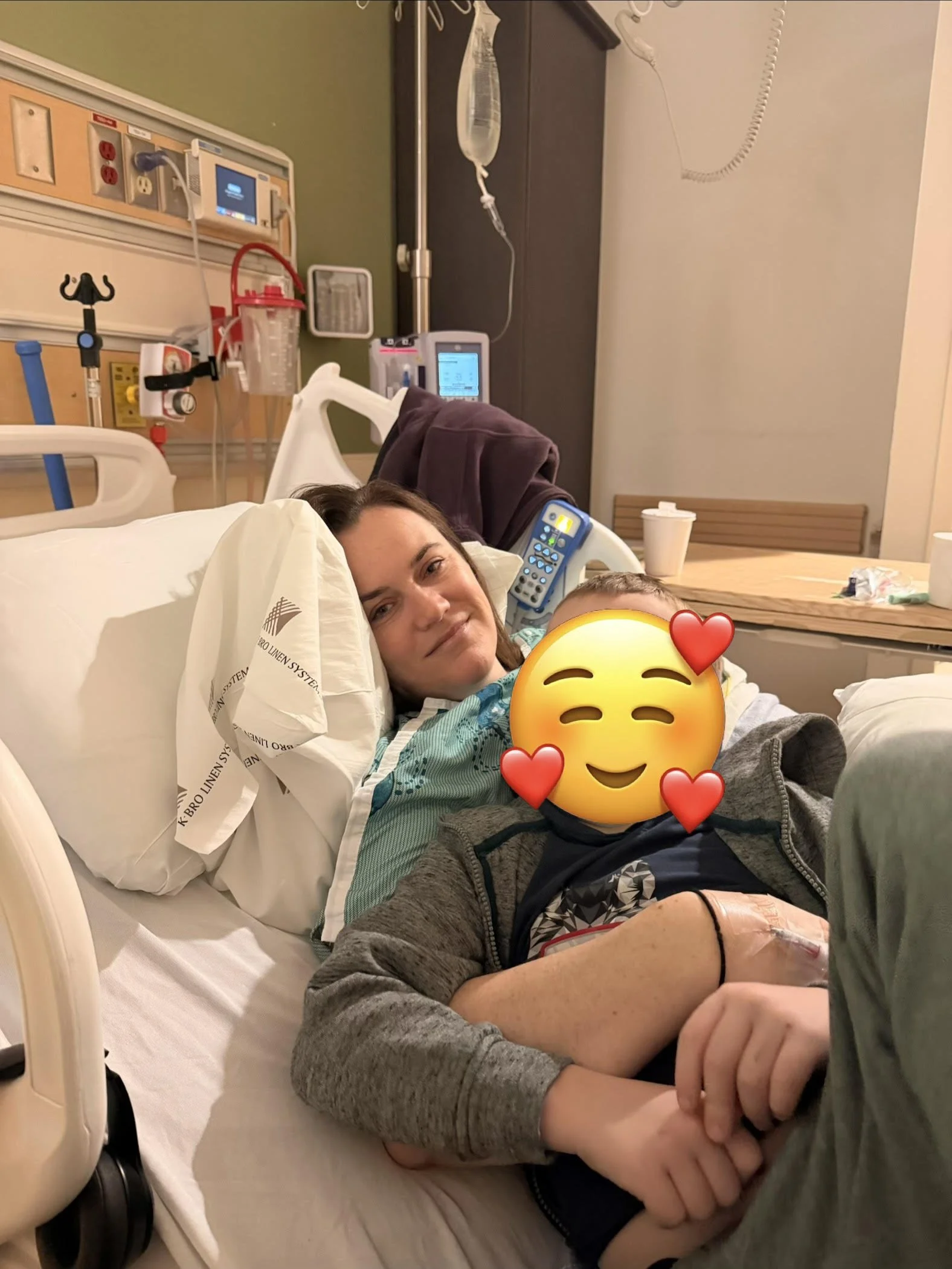
Snuggles from my son are the best kind of medicine.
Unfortunately the cause of my near fatal hemorrhage remains unclear. I will be following up with my gastroenterologist. If I thought that the stress of living under the metaphorical Sword of Damocles of MS was bad, this has brought it to a whole new level. I’m petrified that I could hemorrhage like this again.
I am slowly recovering. Let me tell you, MS fatigue has nothing on the fatigue of recovery from catastrophic blood loss! The transfused unit helped to stabilize me, but most of the rebuilding has to be done by my own bone marrow. The body prioritizes restoring circulating volume so that organs get oxygen. Fluid shifts from tissues into blood vessels and IV fluids expand plasma volume. This happens in the first 3-5 days after a significant hemorrhage. Next red blood cell production ramps up. This peaks at around 2-3 weeks post-hemorrhage. Anemia can slow this process dramatically. With good iron supply, I can expect to see my hemoglobin rise approximately 10 g/L every 7-10 days. Even if my hemoglobin improves quickly, my iron stores could remain depleted for months. I met with my family doctor yesterday and he will be monitoring my recovery, including keeping a watchful eye on my hemoglobin and iron levels. I received a unit of IV Venofer before being discharged from hospital. The vein in my hand where I received this transfusion is still sore nearly two weeks later. My family doctor now has me started on a three month supply of oral 300mg Ferrous Fumarate.
My family doctor broke the news to me that my biopsy results suggest Inflammatory Bowel Disease (IBD). IBD happens when the immune system misfires and attacks the lining of the intestines. Here I’ve been bracing for a fresh attack on my brain, spinal cord, or optic nerves, and then bam, out of nowhere my immune system decides on a new target that I never saw coming! There are two main types of IBD: Crohn’s Disease and Ulcerative Colitis. I don’t yet know which form of IBD I am contending with, but that’s on the list of things to follow-up on with my gastroenterologist. I’m frustrated to be adding a third chronic illness to the list of “what’s wrong with me”. In fact, this is the understatement of the year. I’m also confused, because I don’t have any of the typical symptoms of IBD:
Chronic of recurring diarrhea - no
Abdominal pain or cramping - no
Blood or mucus in the stool - none prior to the hemorrhage and none since it resolved
Urgency or feeling like you can’t fully empty your bowels - no
Fatigue - yes, but I also live with MS
Weight loss or poor appetite - I wish!
Anemia - none prior to the hemorrhage
Widespread inflammation observable on scope - I only had mild inflammation in the cecum, and otherwise nothing unusual was observed
I’m also worried that the IBD was an incidental finding, or while a contributor not the sole cause of the hemorrhage. A hemorrhage of the magnitude that I experienced is atypical for IBD-related bleeding. IBD-related hemorrhage usually occurs in the setting of severe disease activity, usually preceded by weeks to months of inflammatory symptoms and with widespread inflammation and/or deep ulcers visible on the scope. It is possible that the immune suppression from my MS treatment and/or my ongoing low-dose prednisone use for my adrenal disease could be contributing to this atypical presentation. Despite the IBD diagnosis, I find myself left with more questions than answers.
IBD may complicate my MS treatment. Certain IBD treatments are incompatible with certain MS treatments. However, Tysabri treats both MS and Crohn’s Disease and Zeposia treats both MS and Ulcerative Colitis. Once I get a more clear diagnosis, I may have to switch to a new Disease Modifying Therapy (DMT). I’m not super keen on the prospect of having to switch from Kesimpta, which has been effective at keeping my MS quiet for the past 4.5 years with minimal side effects. Transitioning to a new DMT is always a scary proposition, because you just don’t know how your body will take to it. That’s a bridge to cross on another day, but one that I’m already dreading.
I am continuing to experience lightheadedness. This is apparently very common after catastrophic blood loss. This is likely because my hemoglobin and iron stores remain well below my baseline. I am assured that this doesn’t necessarily mean that something is wrong. Recovering from something this traumatic takes time. Some days I’ll seem almost normal, and the next day I’ll hit a wall. That’s apparently typical after massive blood loss.
As you’ll know if you read my last blog post, Canadian Blood Services recently updated their policies to allow Canadians living with MS to donate blood. I made my first ever blood donation on January 8, 2026, after years of ineligibility. I once again find myself ineligible to donate blood. Is the universe trying to tell me something? I will not be allowed to donate blood again until after I fully recover from the hemorrhage, and even then if it turns out that my IBD is Crohn’s Disease, I will once again find myself permanently ineligible to donate. For those who can donate blood, I encourage you to do so. Some kind A+ donor (perhaps it was my earlier self) saved my life with their donation.
The scariest part of this whole ordeal for me is the risk that it could happen when I don’t have quick access to a hospital. Hospital care was life saving in this instance. A delay of even an hour likely would have resulted in my death. I often camp, canoe, and hike in places well off grid. The idea of this happening while in the backcountry of Algonquin or Killarney Provincial Parks is terrifying. Yet I also don’t want to give up backcountry camping because it is truly one of my great sources of joy in life. I don’t want to live my life afraid to really live it. I previously wrote about how being diagnosed with MS has changed my approach to backcountry camping in a blog post titled: “Getting Comfortable with being Uncomfortable”. I now find myself revisiting my risk management approach once again. While I have a Search and Rescue Insurance Plan through Garmin, hitting the SOS button on my Garmin inReach Explorer+ almost certainly wouldn’t have gotten me to hospital care in time to survive this hemorrhage and the resulting hypovolemic shock. I’ll need more input from my gastroenterologist, particularly around recurrence risk, before I can appropriately weigh the pros and cons of resuming my usual adventurous lifestyle.
I find myself unexpectedly participating in “Dry February” as I will have to remain a teetotaller until we get a better understanding of what caused the bleed, or at least until we can rule some things out which could be exacerbated by alcohol. My newfound IBD diagnosis means that even if I do get the green light to consume some alcohol again in the future, it will be more strictly limited than it has been in the past. I’m hoping that I won’t have to say farewell to red wine forever, but that could be in the cards too. Chronic illness has a remarkable capacity for sucking every small joy out of life.
I live my life knowing that, thanks to MS, a relapse can happen at any time, but I sure didn’t have “random near-fatal hemorrhage” on my 2026 bingo card. My immune system is supposed to protect me from pathogens, but at this point it’s giving very little “protective mechanism” energy and a whole lot of “rogue vigilante with poor judgment” energy. I’m feeling pretty useless at the moment, like a toy that’s been dropped a few too many times, but I’m grateful to be alive and I’m working on getting up, dusting myself off, and figuring out how to start putting one foot in front of the other again.