Ms. Frizzle Would Approve
When I was a kid, The Magic School Bus made shrinking down and taking an educational detour through someone’s gastrointestinal tract seem downright whimsical. At the time, there was no such thing as a capsule endoscopy. The first human test of a capsule endoscopy occurred in 1999, and it was officially approved for medical use in 2001. The Magic School Bus was ahead of its time.

Over the lips and past the gums, look out stomach, here it comes! In episode 2 of The Magic School Bus, the class gets a PillCam-sized view of their classmate Arnold’s gastrointestinal tract.
I experienced a catastrophic gastrointestinal hemorrhage on January 27th. You can read more about that in my previous blog post, titled Plot Twist: Surviving a Catastrophic Gastrointestinal Hemorrhage and Discovering my Immune System is at it Again. Since then, a colonoscopy, an upper endoscopy (esophagogastroduodenoscopy), and two CT scans have failed to identify the cause of the hemorrhage.
Capsule endoscopy is fully funded by OHIP (Ontario’s publicly funded health insurance plan), but only under specific medical circumstances. It is primarily available to investigate obscure gastrointestinal bleeding. In other words, when a patient is bleeding or bled a lot and no standard test has been able to locate the source of the bleeding. Being a medical mystery meant that I would be getting the full “Magic School Bus” experience… I personally would have preferred to participate in the space exploration episode.
Capsule endoscopy is a mind-blowing piece of medical technology. Instead of undergoing invasive procedures with sedation, patients simply swallow a large vitamin-sized single use capsule containing a camera, LEDs, and a wireless transmitter. It passively travels through the gastrointestinal tract, capturing tens of thousands of high-resolution images. The pictures are sent to a recorder worn on a belt around the waist. Artificial intelligence algorithms now assist doctors by analyzing the video assembled from the thousands of images captured, reducing review time drastically.
On May 4th, I once again ventured to the hospital to see my gastroenterologist in the hopes of gaining an explanation for my near-death experience in January. I arrived at the hospital shortly before 7am and soon was presented with a PillCam to swallow and a sensor belt and receiver to carry with me for the day. I was then instructed to walk around the hospital until the PillCam had made its way out of my stomach. This is because in rare instances the PillCam is slow to progress out of the stomach, and sometimes gastroenterologists have to intervene and manually push it along via gastroscopy. Thankfully that wasn’t necessary in my case, and I was sent home once it was confirmed that it had made its way into my small intestine. I returned home and spent the day working. I had to return to the hospital later in the afternoon to return the equipment. You can access live images on the receiver, so I was periodically checking in on the PillCam’s journey through my gastrointestinal tract throughout the day.
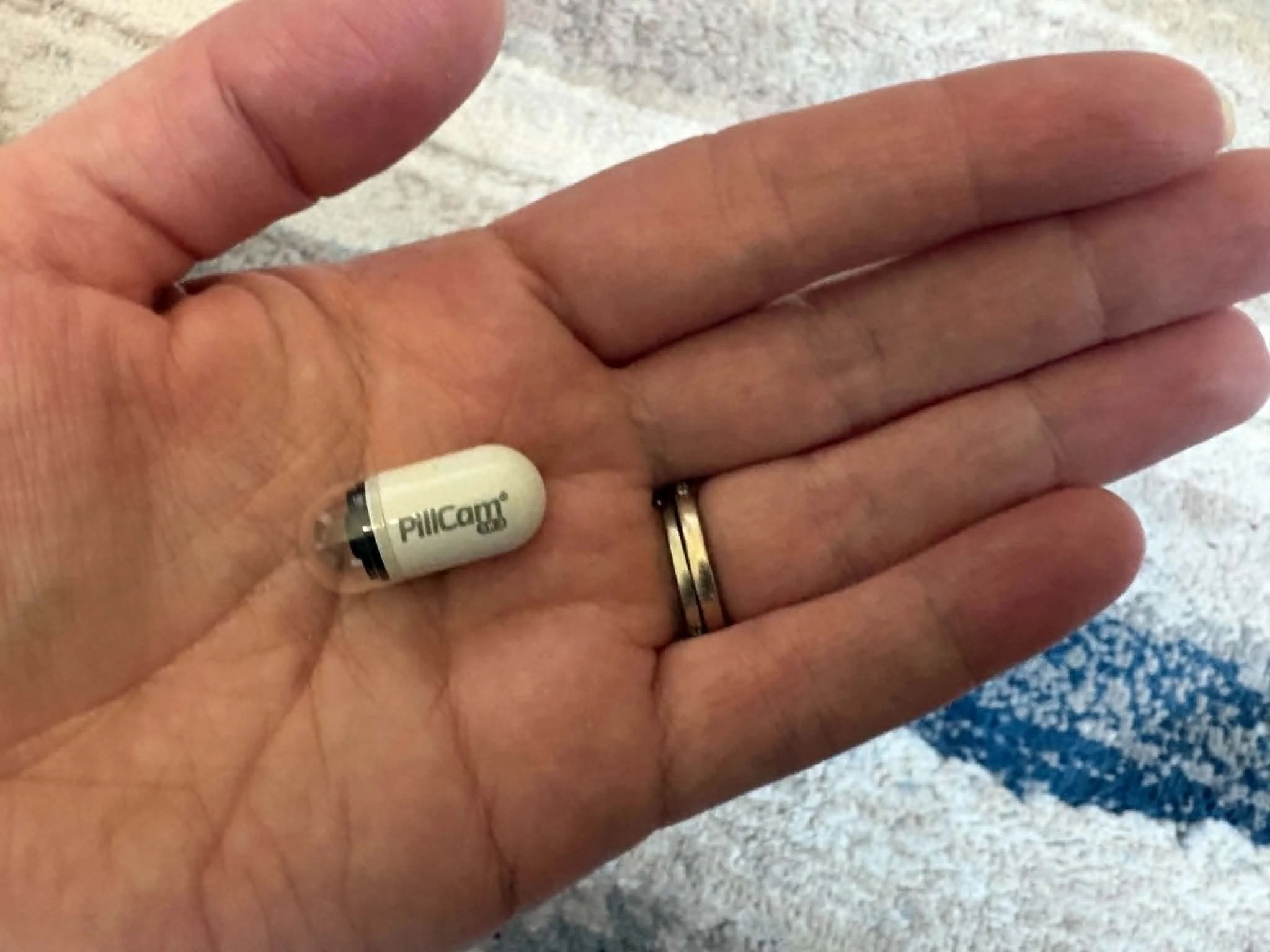
My gastroenterologist called me later that same day with the results. The capsule endoscopy found nothing new. It captured the same mild inflammation in the cecum (the area where the small intestine and large intestine meet) that he had observed previously during my colonoscopy, but no other irregularities and nothing that could explain my catastrophic hemorrhage. On paper, this is good news. A normal test is always preferable to finding something serious lurking where it shouldn’t be. I am deeply grateful that nothing dangerous showed up. But if I’m honest, “normal” can also be a strangely uncomfortable result. While a normal test brings some relief, it also leaves behind uncertainty. There is still no explanation for my near-fatal hemorrhage. No clear reason why it happened. No neat answer. No satisfying final scene where Ms. Frizzle points to a diagram and says, “Aha! There’s the problem!” I’m left with the uneasy reality that I will likely never know what caused me to nearly bleed out on a random Tuesday in January. Not knowing is its own kind of exhausting.
I continue to exist in diagnostic limbo. My gastroenterologist advised that, but for my history of taking Kesimpta, I would be diagnosed with Crohn’s colitis. However, it is still very much possible that Kesimpta has induced the inflammation that he has observed in my cecum. I will have to wait until I’ve been off Kesimpta for some time before a determination can be made about whether this is Kesimpta-induced colitis or Crohn’s Disease. I’ll be sent for a follow-up colonoscopy in a few months’ time to evaluate.
In good news, I’ve finally received insurance approval for my next Disease Modifying Therapy (DMT), Mavenclad. Now I’m just waiting for the final green light from my neurologist so that I can get started. I have a Zoom meeting with him tomorrow, so I’m hopeful that I will be able to start my next DMT any day now.
There are just 6 days left until the MS Walk and the Life Among the Clouds team is just $925 from reaching our $5,000 fundraising goal. Can you help us cross the finish line? To donate: https://msspwalk.donordrive.com/participants/79897